

Implementation Levers and Geopolitical Stakes from COP30 & G20
ImageSource: PresidencyZA
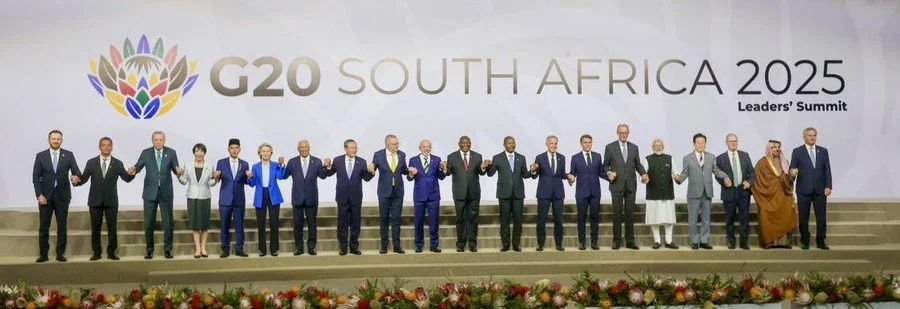
Belém and Johannesburg together shifted the collective agency around climate action and energy access from legal text toward mechanisms for deeper engagement, refinement and the strengthening of financial instruments and plurilateral coalitions. The G20 underscored shifting geopolitical interests and global power dynamics, positioning Africa and the Global South at the centre of the climate discourse.
Similarly, Brazil’s COP30 presidency sought to highlight disparities between the Global North and the Global South, particularly in adaptation and mitigation, and to balance the scales. Amid the volatile geopolitical climate (or possibly due to it), both COP30 and the G20 produced similarly mixed outcomes. Both fora have led to crucial political signalling (increasing adaptation targets, pledges on renewables, a G20 Critical Minerals Framework); however, they both lack enforceable commitments, accountability mechanisms and adequate, predictable and affordable finance.
The US’s absence at both COP30 and G20 indicates a decline in its role as a global norm-setter in multilateral spaces. This absence, combined with China’s reluctance to assume a leadership role at COP30, and the EU’s more hard-line, finance-averse posture, opened a geopolitical vacuum. This vacuum enabled South American and African actors to exercise greater agenda-setting influence, contributing to a discernible reshaping of multilateral priorities and decision-making dynamics. While this also creates opportunities for African agenda setting, it is also indicative of the volatile geopolitical environment and fragmented state of climate affairs.
As such, Africa finds itself at the nexus of opportunity and risk. Key issues to a just and equitable African transition (such as adaptation, local beneficiation and industrialisation) have received stronger political attention. On the other hand, risks involving lopsided bilateral agreements and financial conditionalities in multilateral settings threaten this moment. How Africa wields its strategic leverage in negotiations on climate finance, energy and industrialisation will essentially shape not only the continent’s climate response, but climate action globally.
COP30 Deliverables
Global Mutirão: COP30 delivered a Belém implementation package containing implementation accelerators, adaptation indicators, and headlines focused on tripling adaptation finance. Timelines, baselines, grant versus loan share and even delivery mechanisms, however, remained vague.
In addition to that, COP30 delegates discussed the fossil-fuel phase-out agenda, stopping short of a binding instrument. Momentum on this, and similar mitigation conversations, seems to be moving into coalitions and roadmaps outside of the formal COP text.
G20 Deliverables
Joint Leaders’ Declaration: G20 similarly delivered a climate-focused Leaders’ Declaration, in the face of strong US opposition and in the absence of supportive working group Ministerial texts on climate change, reaffirming commitments to renewables and energy efficiency in political terms, prioritised blended finance mechanisms rather than public grant pledges and welcomed a (non-binding) G20 Critical Minerals Framework.
The G20 texts promoted local value addition as a political objective; however, the implementation specifics and enforceability also remained vague.
From Pledges to Power: Parallels and Key Contrasts
Implementation mechanisms versus Legal commitments
Both forums focused on operational mechanisms over legally binding obligations. Implementation modalities such as the Transition Implementation Plan and the COP30 Implementation Accelerator, Adaptation indicators under the Global Goal on Adaptation for COP30, and national and sectoral roadmaps and the Mission 300 initiative for G20, replaced legal commitments as the locus of action. This increases the role of MDBs. bilateral lenders and private financiers, and in turn increases the influence of actors who have leverage over concessional capital, guarantees and procurement standards. Nonetheless, it is important to note that this did not reflect a unanimous abandonment of legal approaches. On the contrary, several parties advocated for legally framed commitments, particularly on climate finance. The move towards implementation coexists with continuing demand for legally anchored delivery.
2. Finance: Signalling versus Delivery
High debt burdens hinder Africa’s ability to absorb climate finance. Without relief or concessionality, implementation pledges are simply absorbed by debt-servicing pressures instead of new resilience spending. Both G20 and COP30 produced politically direct headline targets linking debt-sustainability to the global South’s ability to access climate finance. COP30 headlined the commitment to tripling adaptation finance. Innovative financing instruments (contingent credit lines, resilience bonds) were also unveiled, intended to mobilise private and public capital without increasing sovereign debt burdens. The G20 made similar headlines, committing to scaling renewables and increasing energy efficiency by 2030 via arms like Mission 300. There was also a call for more concessional and innovative instruments, and debt-for-climate approaches. That being said, they both deferred the mechanics of delivery to MDB reform, private capital mobilisation, blended finance and rechanneling SDRs. Debt has therefore become a geopolitical filter: control over first-loss capital, political risk insurance, guarantees and other derisking instruments becomes imperative in North-South negotiations.
3. Energy Security over rapid fossil fuel phase-out
While neither forum produced a legally binding stance on fossil fuel phase-out, COP30 addressed the phase-out agenda. Mitigation momentum has shifted from the formal UN package into ad hoc political statements, roadmaps and coalitions. To illustrate, anticipation for the post-COP30 2026 First International Conference for the Phase-out of Fossil Fuels co-hosted by Columbia and the Netherlands shows support for the phase-out agenda, despite petrostates lobbying against a binding phase-out instrument. The G20 explicitly regarded energy security as part of the national sovereignty of member states. Fossil fuels are thus considered potentially pivotal to ensuring development and security for member states, as is their sovereign right. This results in leeway for policies and arguments that retain fossil options, alongside renewables.
4. Critical Minerals: The question of Recognition
Similarly, while neither forum produced a legally binding instrument in relation to critical minerals, Johannesburg at least elevated critical minerals and endorsed a voluntary G20 framework that addresses supply-chain resilience and local beneficiation. This framework (though non-binding and limited in impact until finance and enforceable standards are determined) creates political leverage for the African industrialisation agenda. On the other hand, Belém faced opposition in including critical minerals under the Just Transition Work Programme. Powerful mineral-processing states lobbied for their removal from the agenda, citing arduous trade and industrial-policy disputes being included in UNFCCC texts as problematic. In a period of rapidly rising mineral demand, this omission from the outcomes leaves mineral governance outside of COP’s formal remit. As such, the likelihood of extractivism, green colonialism and the undermining of equity in the energy transition increases.
Conclusion
Belém and Johannesburg signal a shift in the approach of climate action, from legally binding instruments to implementation tools such as sectoral coalitions, roadmaps and frameworks. Without collective African bargaining, the landscape will likely shift toward competition and coalitions outside of the formal environments: plurilateral coalitions such as the Mineral Security Partnership, Africa-EU Critical Minerals Partnership and most recently, the fossil-phase-out coalition; Bilateral deals such as the EU-South Africa Clean Trade & Investment Partnership and the strategic competition over standards, finance, minerals, technology and political influence.
Subscribe to our newsletter below and stay informed on the latest updates, engagements, and news!
